You can't stop scrolling because feeds stack four well-understood psychological mechanisms together: unpredictable ("variable") rewards, no natural stopping cue from infinite scroll, FOMO and social comparison, and notification-trained habit loops. It isn't a personal failing — it's a predictable result of the design. The more reliable fix is removing the trigger from view, not just trying to resist harder.
"Doom scrolling" gets used loosely — sometimes it just means "scrolling too much," sometimes it specifically means feeding yourself bad news on a loop late at night. Either way, the experience underneath is the same: you intend to check your phone for thirty seconds, and some much longer, less intentional stretch of time happens instead. It's worth understanding why that happens, because the mechanism is not a personal failing — it's a predictable result of how feeds and notifications are built.
Nothing below is a claim about a specific study or a specific statistic. It's a description of well-established, general psychological and behavioral concepts — the kind covered in any intro psychology course — applied to how modern apps are actually designed. The goal is to name the mechanism clearly enough that you can recognize it while it's happening to you.
The variable reward loop
One of the oldest and best-understood ideas in behavioral psychology is that unpredictable rewards are more compelling than predictable ones. If you knew pulling a lever gave you a reward every single time, you'd pull it, get the reward, and stop needing to. If you don't know whether this pull will be the good one, you keep pulling — that uncertainty is what keeps the behavior going. This is the same basic mechanism behind slot machines, and it's not a coincidence that social feeds share a structural resemblance to one.
Every time you refresh a feed, you don't know in advance whether the next post will be boring, mildly interesting, or genuinely delightful. That unpredictability is the point. A feed that was uniformly interesting or uniformly boring would be easy to stop scrolling. A feed that's unpredictable keeps your brain's prediction system engaged, because it hasn't yet seen a result worth stopping on — the next pull might be the good one.
Infinite scroll removes the natural stopping point
Before infinite scroll was standard, reading a feed looked more like reading a newspaper page or a forum thread — it had an edge. You'd hit the bottom, see "no more posts," and that was a natural cue to put the device down. Infinite scroll removes that cue entirely. There is no edge. The content doesn't run out; it loads more. Decision psychology calls the related general idea a stopping cue — a signal that tells you a unit of an activity has ended and it's a reasonable moment to decide whether to continue or stop. Remove the stopping cue, and people tend to keep going well past the point they would have paused on their own, simply because nothing in the environment prompted the choice.
This is a deliberate design choice, not an accident. A feed that occasionally forced you to tap "load more" gives you dozens of small decision points to leave. A feed that scrolls forever gives you zero. Fewer decision points means the default behavior — continuing — just keeps happening.
FOMO and social comparison keep the loop running
Underneath the mechanical design, there's a social layer doing its own work. Fear of missing out — FOMO — is a well-known, generally understood driver of checking behavior: the sense that something relevant, urgent, or socially important might be happening right now, somewhere in your feed, and you'll be behind if you don't look. Combined with social comparison — the normal, well-documented human tendency to evaluate yourself against what you see others doing — a feed becomes a steady low hum of "what's everyone else up to," which is a genuinely hard pull to ignore even once the content itself stops being interesting.
This is part of why doom scrolling often doesn't feel pleasant even while it's happening. You can be comparing, worrying, and checking all at once, without any single post actually being enjoyable. The scrolling isn't driven by delight at that point — it's driven by the itch of "is there something I'm missing," which checking a feed never fully resolves, because there's always more feed.
Notifications are the trigger, not just a reminder
Habit-loop theory — another broadly accepted idea in behavioral science — describes habits as a three-part cycle: a trigger, a behavior, and a reward. Over time, repeated enough, the trigger alone starts to produce the behavior almost automatically, without much conscious decision involved. A badge count, a buzz, a lock-screen preview — these are triggers. The open-and-scroll that follows is the behavior. The small hit of novelty or social validation is the reward. Once that loop runs enough times, you don't really decide to check your phone when it buzzes; your hand is already moving before the decision finishes forming.
This is why notification design matters so much more than people assume. It's not just "a reminder that something happened" — it's actively training a reflex. Every badge and buzz is another repetition of the same trigger-behavior-reward cycle, strengthening the automatic response a little more.
Why willpower alone usually loses
None of this means you lack discipline. It means the loop is specifically engineered around variable reward, removed stopping cues, social pull, and trigger-based habit — four separate, well-understood psychological mechanisms stacked on top of each other, all pointed at the same fifteen seconds of attention. Trying to beat that with willpower alone means fighting all four mechanisms, every single time, using a finite resource (your in-the-moment self-control) against a system that doesn't get tired.
The more reliable approach, according to the same general behavioral-science thinking, isn't to summon more willpower — it's to change the environment so the trigger has less to work with. If the app isn't one tap away, the badge isn't visible on your home screen, and reaching it requires an actual search instead of a reflexive tap, the loop loses its easiest entry point. You're not relying on noticing the urge and resisting it; you're removing the thing the urge would have reached for.
A smaller home screen is a smaller trigger surface
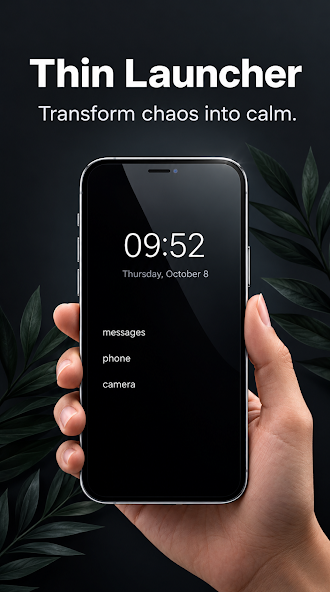
This is the practical link between doom-scrolling psychology and something as simple as how many icons sit on your phone's main screen. Every app icon visible the moment you unlock your phone is a potential trigger, sitting there regardless of whether you opened your phone with that app in mind. Cut the visible set down to a handful of apps you've deliberately chosen, and the reflexive, no-thought tap has far fewer places to land. If a doom-scroll-prone app isn't one of your chosen few, it's a deliberate search away instead of a thumb's reach away — which is exactly the kind of small added friction that interrupts a trigger-behavior-reward loop before it starts.
This is the core idea behind Thin Launcher: a hard limit of 7 apps on the free tier (11 on Pro, a one-time purchase) on your home screen, with everything else tucked into the app drawer, a search away. It doesn't track your usage or block anything by schedule — it just removes the reflexive trigger from view, which is often the only part of the loop you can realistically control.
If this kind of environment-first thinking interests you, our piece on phone minimalism and a simpler home screen goes further into why fewer choices on your screen leads to calmer, more intentional use overall. And if you're curious how this same loop shows up in lower-effort content consumption specifically, see our piece on what "brain rot" actually means.